

Home / Locations / Hickory, North Carolina
Your business. Your next chapter.
Business Broker in
Hickory, North Carolina
Make the knowledge behind the finished furniture visible
Working with a business broker in Hickory begins with a clear account of the company you actually operate. Bridge Point Advisors welcomes a discussion about your plans and preparation for a potential ownership change. An upholstery or furniture service enterprise can depend on retained patterns, customer choices and skilled judgment alongside frames, machines and materials. Show how those resources work together through completed jobs and supported results. A buyer needs to understand the practical offer, the responsibilities already accepted and the knowledge held by staff before deciding how the business might operate after the proprietor leaves. Bridge Point Advisors can help organize those facts around your selling goals — without inventing a Hickory street office.
Or call (352) 515-0226
Catawba County — furniture, campus, and regional customers kept on the company's own book
Bridge Point Advisors for Hickory owners — without a claimed local street office
Bridge Point Advisors helps Hickory and surrounding owners present their companies clearly — without treating a civic caption, undated directory listing, or leftover peer-metro multiple as twelve months of private earnings. Call (352) 515-0226. Soften sale talk — no Proven Track Record slogans or Key Market Stats widgets. We work nationally from Spring Hill.
Bridge Point Advisors
Hickory, NC and surrounding areas. We work nationally from Spring Hill and do not list a fake Hickory street office or unverifiable local hours.

AI-generated editorial illustration. Not a photograph of an actual local business.
The market behind your business
Keep regional skills, campus work and public connections in context
Catawba Valley Community College describes its Furniture Academy as an industry-driven program with instruction including pattern making, cutting, sewing and upholstery. Its Corporate Development Center page lists the academy at 973 Locust Street in Newton.[1] An owner preparing to sell a business in Hickory should distinguish a regional training resource from skills already available inside the company. A public course description cannot establish employee proficiency or retention. Explain what the current team can actually demonstrate and identify additional learning as a separate matter for investigation.
Lenoir-Rhyne University's Hickory directions page gives its campus address as 625 7th Avenue NE.[2] A seller describing university-area work should preserve the actual customer, building and accepted scope in private records. Individual purchases, outside intermediaries and authorized university orders are different commercial relationships. The public address provides geographic context, rather than an account the business can automatically include in a sale. Another operator needs the evidence supporting actual income and any arrangements whose continuation requires more detailed review.
The city's Riverwalk information distinguishes the existing Riverwalk from future connections, including OLLE Art Walk and a future pedestrian bridge across Lake Hickory. Its stated path use is pedestrian and bicycle activity, with fishing from the Riverwalk bridge prohibited.[3] Keep an amenity's purpose and project stage accurate when discussing commercial surroundings. A public trail does not establish a private sales channel or supplier right. A buyer needs company-specific receipts and access arrangements before assigning business value to a nearby destination or treating a planned connection as a completed operating resource.
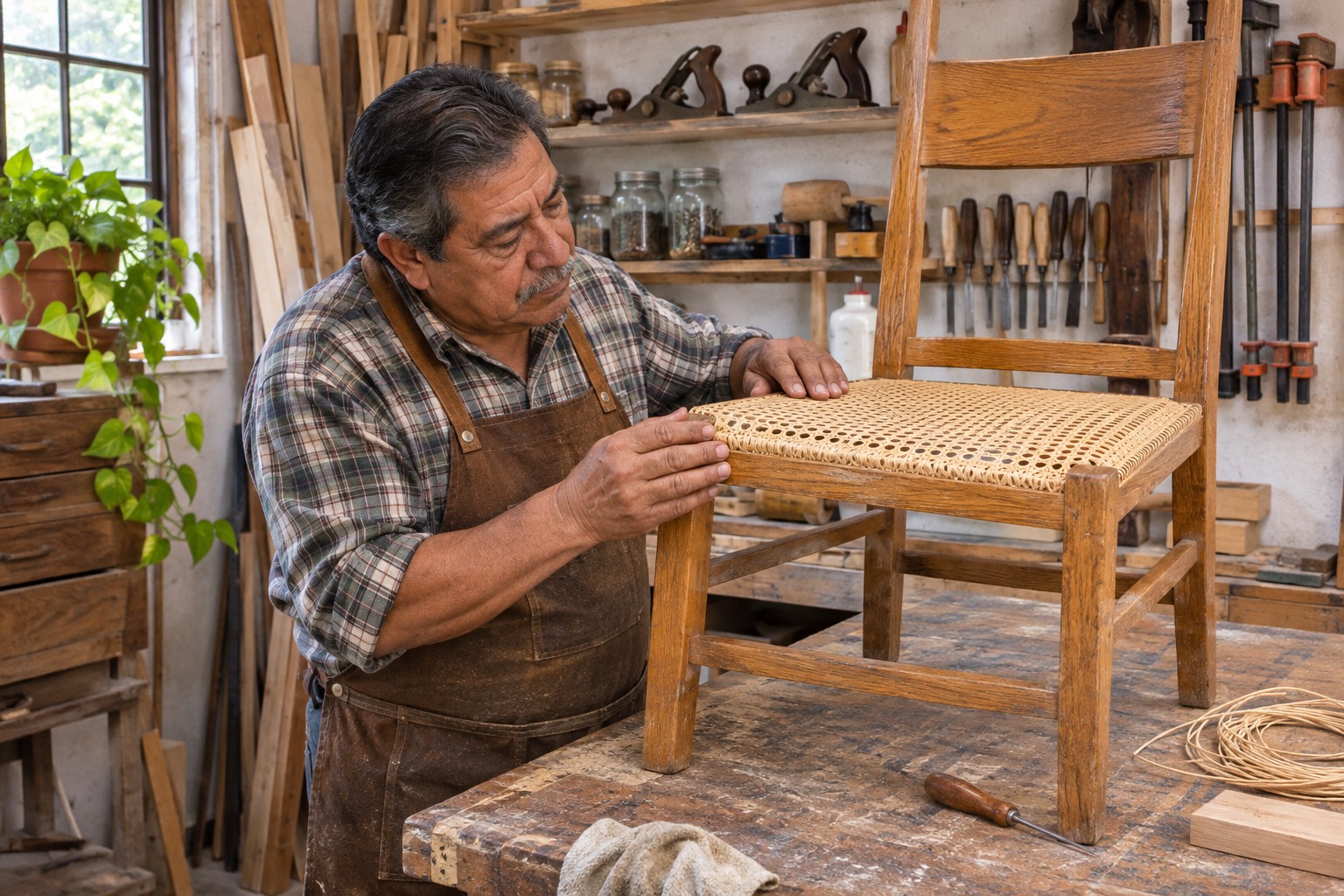
The illustrative scene shows a strip of upholstery webbing beside an unfinished chair frame. It depicts a fictional workshop, not an actual Hickory manufacturer, college partner or institutional supplier. The detail makes an operating question tangible: which specification and customer approval govern the next step? Another owner needs to understand how staff retain those decisions, what they can perform independently and when a condition requires further assessment. A machine list or finished showroom sample cannot explain every judgment behind the service the company has agreed to deliver. Soften sale talk — no fake Proven Track Record slogans or an unverifiable Hickory street office for Bridge Point Advisors. Compare with Morganton, Newton, Lenoir, Statesville, Lincolnton only on each company's own files.
Navigating the Hickory business market
Keep the Hickory file measurable
Before you sell your business in Hickory, identify the dates on which your own trading changed. Use sales and cost records to explain the result after the relevant period has occurred.
Working capital is the cash, inventory, deposits, and receivables a normal week needs so the buyer can make payroll. On this file the normal week is a quiet midweek — not a festival Saturday or a single project spike. Use the sale-prep roadmap before marketing begins.
Local context. Practical implications.
Trace the order from the accepted choice to the finished item
Begin with the actual offer. New production, reupholstery, limited repairs and material sales carry different commitments where the company undertakes them. Explain each demonstrated activity through its transactions. A chair present in the workshop might be customer property, an owned sample or an item awaiting assessment. Another operator should not have to infer its position from appearance. Connect the physical item with ownership, the accepted instruction and the current stage of work before presenting a stock or asset total for the proposed sale.
Retained specifications can carry practical knowledge beyond a pattern's outline. Show how fabric choice, dimensions, appearance decisions and later changes reach the people doing the work. Explain who may approve a variation. A sample accepted by a customer differs from an unconfirmed preference. If inspection reveals a condition outside the original request, record the issue and the route for further discussion. A buyer needs the latest instruction and its authority, rather than an assumption that a previous job can be repeated from the proprietor's memory.
Describe the resources supporting production or repair. Frames, fabric, filling and smaller components may have different ownership, condition and availability. Some materials may be reserved for current jobs or supplied by the customer. Explain how staff find the right reference and identify stock that no longer supports ordinary work. The illustrative webbing cannot establish suitability for a specific chair. Another owner needs the selection process and the limits of the company's capability before assuming that all material physically present is useful inventory available for new orders.
Measure contribution across the complete accepted task. Consultation, preparation, dismantling, cutting, sewing, assembly, checking, delivery and later attention can use resources beyond the main workshop stage. Include outside purchases and owner time. Explain incomplete historical detail instead of supplying unsupported precision. Regional training and local institutions provide context,[1][2] while the company's records establish the work and costs. A buyer needs to investigate the actual earning process before treating craftsmanship, a recognizable setting or visible equipment as proof of repeatable operating contribution.

AI-generated editorial illustration. Not a photograph of an actual local business.
A different sale story for every company
Key industries in Hickory
What owners should prepare before taking a business to market — qualitative preparation, not hard deal tallies.
Upholstery and furniture services
Explain accepted specifications, material ownership and the skills required for the actual offer. A buyer needs completed examples and the current job position. Identify decisions handled by staff and those requiring the proprietor. Machines and fabric rolls cannot establish that every request falls within the company's capability. Show how the team recognizes a condition requiring more information, customer approval or outside assistance before further work is promised. See furniture store.
Furniture-related supply and small production
For a company supplying materials or components, describe useful stock and the customers who actually purchase it. Compatibility, condition and reserved items matter alongside quantity. Explain purchasing judgment and the information staff retain. The regional academy's course subjects show an educational context,[1] but cannot establish an individual seller's technical competence, available workforce or private account. Another owner needs the company's own evidence before assessing what its inventory and production resources can support. See furniture store.
University-area commercial work
Lenoir-Rhyne identifies its Hickory campus on 7th Avenue NE.[2] Locate actual deliveries and service work through private records. Keep the purchaser separate from the destination. A student purchase differs from a university order or an outside contractor's request. A buyer needs accepted scope, costs and current arrangements. The public campus address cannot establish commercial access, continuing authorization or guaranteed repeat contribution after ownership changes. See retail.
Trail-area retail and visitor services
The city distinguishes existing Riverwalk facilities from future connections and identifies pedestrian and bicycle use.[3] Explain the actual relationship, if any, between a seller's trade and that setting. A public amenity cannot make a private supplier agreement part of a business sale. Keep current operations separate from proposed new channels. Another owner needs customer and cost evidence rather than an assumption that every nearby enterprise receives the same benefit from recreational activity. See retail.
Everyday property and commercial support
For companies serving offices, homes or other private premises, identify the actual party authorizing work. Explain service geography, material use and customer communication. A property location may conceal several separate purchasing relationships. A buyer needs ordinary completed jobs alongside larger examples. Show the labor and resources maintaining current contribution, with any proposed expansion treated as a separate investigation requiring capability, working capital and actual customers. See construction.
Valuation & exit prep
Soften valuation talk to supported earnings after a real manager wage — not a civic caption or leftover peer-metro multiple as twelve months of private profit. See business valuations and the sale-prep roadmap.
The ownership transition
Transfer the decisions behind patterns and material choices
Soft process steps aligned with Bridge Point Advisors practice — not invented close counts or a claimed Hickory desk.
Understand the business
Orientation can compare a routine item with a job that required further customer discussion. Show the accepted instruction, retained reference, ownership record and checks where those steps belong to the offer. Explain when staff may act and when they seek help. The illustrative strip is one component within a wider furniture promise. A machinery tour cannot communicate every judgment affecting suitability, contribution and the point at which the company's responsibility for the work has been fulfilled.
Prepare the presentation
Define potential assistance through duties and realistic availability. Reviewing open work, explaining pattern records and introducing an outside resource support different needs. Retain useful answers in a place staff can consult later and give unresolved matters a responsible owner. Appropriate advisers should address formal arrangements. The objective is a company another operator can investigate through retrievable information and demonstrated skills. Transition assistance should resolve specific remaining dependencies, without assuming ordinary buying and production decisions will depend indefinitely on the departing proprietor's recollection of earlier customer choices.
Plan the transition
Match seller assistance to accepted obligations and resources already available in Hickory.
Due diligence
Due diligence — test lease, licenses, customer concentration, and quiet midweeks against local evidence — not a peer metro leftover.
Closing and transition
Closing and transition — hand over routines, contacts, unfinished work, and a clear endpoint so the buyer can run the next week without the founder.
Use the sale-prep roadmap and due diligence guides. M&A advisory fits when the company and buyer require that level of engagement.
Local market perspective
Examine capacity through complete jobs and retained knowledge
Business brokerage in Hickory should connect performance with the work the company can realistically deliver. Regional training provision may be useful to investigate,[1] but the current team and its demonstrated capability remain central. More machines cannot resolve every missing approval, material constraint or skill dependency. Explain how accepted work is allocated and who recognizes a problem before it affects completion. A buyer needs an account of the present operation that remains understandable without assuming a new hire or future training program will supply missing capacity.
Compare periods through job mix and practical resource use. A run of similar new items can differ from individual repairs needing more assessment and customer discussion. Explain revisions, outside services, material purchases and proprietor time. A stronger revenue total may leave more unfinished commitments or consume material bought earlier. Another operator needs to understand both the result and the work behind it. The city's public projects cannot explain a private workshop's change in earnings without records connecting actual orders, costs and timing.
Possible improvements deserve a defined test. More current patterns or clearer customer choices might reduce uncertainty, while better stock references could improve purchasing information. State measured results only where supported and include the effort required. If the change remains an idea, identify what another owner would need to investigate. A broader service range requires skills and resources before it supplies income. Keep those possibilities distinct from demonstrated contribution so a buyer can assess the business being offered without relying on untested improvements to complete the financial story.
A clearer story for a prospective buyer
Hickory, NC and surrounding areas
Providing local expertise
Nearby markets we also serve
Morganton, North Carolina
Underwrite on its own records.
Newton, North Carolina
Underwrite on its own records.
Lenoir, North Carolina
Underwrite on its own records.
Statesville, North Carolina
Underwrite on its own records.
Lincolnton, North Carolina
Underwrite on its own records.
Spring Hill, Florida
National desk — where Bridge Point lists from.

Begin with a clear picture of your Hickory company
Bring Bridge Point Advisors your objectives, an outline of the actual offer and the information currently available. Explain accepted work, customer property, material ownership and decisions handled personally. An initial discussion can identify preparation for a fuller presentation and matters requiring specialist review. Keep supported performance distinguishable from possible improvements. That gives a prospective buyer a practical basis for investigating the business, the resources maintaining its contribution and the assistance that could support a defined ownership transition. Call (352) 515-0226 or contact us.
Or call (352) 515-0226
Questions from local owners
Frequently asked questions
About selling a business in Hickory, North Carolina
Does the Furniture Academy establish my team's skills?
The college describes a regional training program and lists the academy in Newton.[1] Your business records and demonstrated work must establish current staff capability. Public course provision cannot guarantee an employee's proficiency, future availability or the resources a buyer would receive with a private company.
Does a university address establish a customer account?
The university's directions page locates its Hickory campus on 7th Avenue NE.[2] Private transactions must establish the purchaser, accepted work and commercial relationship. A public address cannot prove supplier access or guarantee that historical spending continues after the business changes ownership.
Should every Riverwalk connection be described as completed?
The city's information distinguishes existing Riverwalk facilities from future connections.[3] Keep project stages accurate and investigate actual access where relevant to company work. A public path or planned connection cannot establish private income or an included right to supply services.
Why retain customer choices beside material records?
A pattern or fabric roll cannot show the latest accepted instruction by itself. Connect ownership, specification, approval and next action. Another operator can then investigate useful resources and unfinished work without assuming every item in the workshop is uncommitted company inventory ready for a new customer.
How do buyers think about value for a Hickory, North Carolina company?
Owner-operated shops often price around two to three and a half times seller's discretionary earnings after a real manager wage. With a lead already holding a quiet midweek, a directional band is often two and a half to four and a half times those earnings. Managed companies often price on adjusted EBITDA, commonly about three to six times near a ten million dollar price. Those ranges are directional, not a quote.
Who helps sell a business in Hickory, North Carolina?
Bridge Point Advisors. Start with a valuation or contact — call (352) 515-0226. The firm works nationally and does not claim a street office in Hickory.
Ready to discuss selling your business in Hickory?
Start with your goals, your recent results, and the company you are ready to transfer. Bridge Point Advisors — call (352) 515-0226. No street address is claimed for Bridge Point in Hickory. Or contact us online.
Or call (352) 515-0226
Local research and sources
[1] Catawba Valley Community College, Corporate Development Center and Furniture Academy information. Reviewed November 5, 2026 Source
[2] Lenoir-Rhyne University, Hickory Map and Directions. Reviewed November 5, 2026 Source
[3] City of Hickory, Riverwalk Information. Reviewed November 5, 2026 Source