

Home / Locations / Fonda, New York
Your business. Your next chapter.
Business Broker in
Fonda, New York
Explain the business between its busiest dates
An owner looking for a business broker in Fonda should be ready to explain more than the company’s busiest event or strongest month. A buyer needs the operating year, the costs behind completed work and the duties still attached to accepted orders. Bridge Point Advisors welcomes discussion of your objectives and the records available to describe those matters. Start with the company you actually run: its customers, working assets, staff routines and your personal involvement. That provides a useful basis for evaluating the proposed business before discussing opportunities another owner might pursue. Bridge Point Advisors can help organize those facts around your selling goals — without inventing a Fonda street office.
Or call (352) 515-0226
Before you go to market
A well-prepared sale starts with clarity
Understand the earnings, protect sensitive information, and prepare for the handover — boutique process, not “proven track record” slogans.
Discuss value in terms of repeatable performance
A business valuation in Fonda should consider supported earnings together with the assets and responsibilities offered. Equipment condition, stock, customer concentration, premises arrangements and owner duties may each require investigation. Explain the assumptions used and the information still missing. Public services, a community library and an annual fair help describe the setting,[1][2][3] but do not determine the price or buyer response for a particular private company. The value discussion needs to remain tied to the business itself. See business valuations.
- Pull civic and seasonal spikes out of run rate
- Show a second lead already opening on a quiet Fonda midweek
- Keep peer-metro comps on their own pages
Seller financing, earn-outs, and SBA financing belong only when records support them. The SBA 7(a) cap is $5 million — not lending advice.
Keep sale discussions controlled while the business operates
A confidential business sale in Fonda needs attention to combinations of clues. A distinctive equipment fleet, unusual booking or recognizable workshop photograph can identify a company even if its name is removed. Shape the opening account around the operating information needed for initial assessment. Reserve sensitive customer identities and supporting records for a suitable stage and agreed handling arrangements. A useful first description can explain working methods and dependencies without unnecessary personal detail about an individual customer or event. Share detailed records through an NDA.
- Qualify buyers before releasing customer identities
- Stage disclosures before landlord or key-vendor introductions
- Test name-collision and peer-metro leftovers against this Fonda rent
Montgomery County — Mohawk Valley event calendar and ordinary midweek trade
Bridge Point Advisors for Fonda owners — without a claimed local street office
Bridge Point Advisors helps Fonda and surrounding owners present their companies clearly — without treating a civic caption, undated directory listing, or leftover peer-metro multiple as twelve months of private earnings. Call (352) 515-0226. Soften sale talk — no Proven Track Record slogans or Key Market Stats widgets. We work nationally from Spring Hill.
Bridge Point Advisors
Fonda, NY and surrounding areas. We work nationally from Spring Hill and do not list a fake Fonda street office or unverifiable local hours.
AI-generated editorial illustration. Not a photograph of an actual local business.
The market behind your business
Identify the purchaser behind a familiar local destination
The Village’s community-resources page explains that Fonda lies within the Town of Mohawk and distinguishes Village, Town and Montgomery County services.[1] When you sell a business in Fonda, name the actual purchasing entity in material public relationships. A shared local address does not make several public bodies one customer. Connect orders, approval and settlement so another operator can understand the account and the work needed to serve it without guessing from a place name.
The Fonda Fair’s official website states that its fair has concluded and discusses preparation for the next edition.[2] Date event-related descriptions accordingly. A seller can explain completed fair-period work using its own records, but should not present a past event as current trading. An organizer, exhibitor, concessionaire and visitor can make separate purchases. The company’s accepted orders establish its relationship and commitments rather than the existence of a well-known event on the surrounding calendar.
Frothingham Free Library identifies its location on West Main Street and publishes a notice about its building addition and rear entrance during construction.[3] A supplier should use current access instructions for the actual destination and distinguish a project from ordinary operations. Public information about a building does not establish a private company’s work there. If the company has a relevant order, explain its purchaser, accepted scope and current status through the company file.
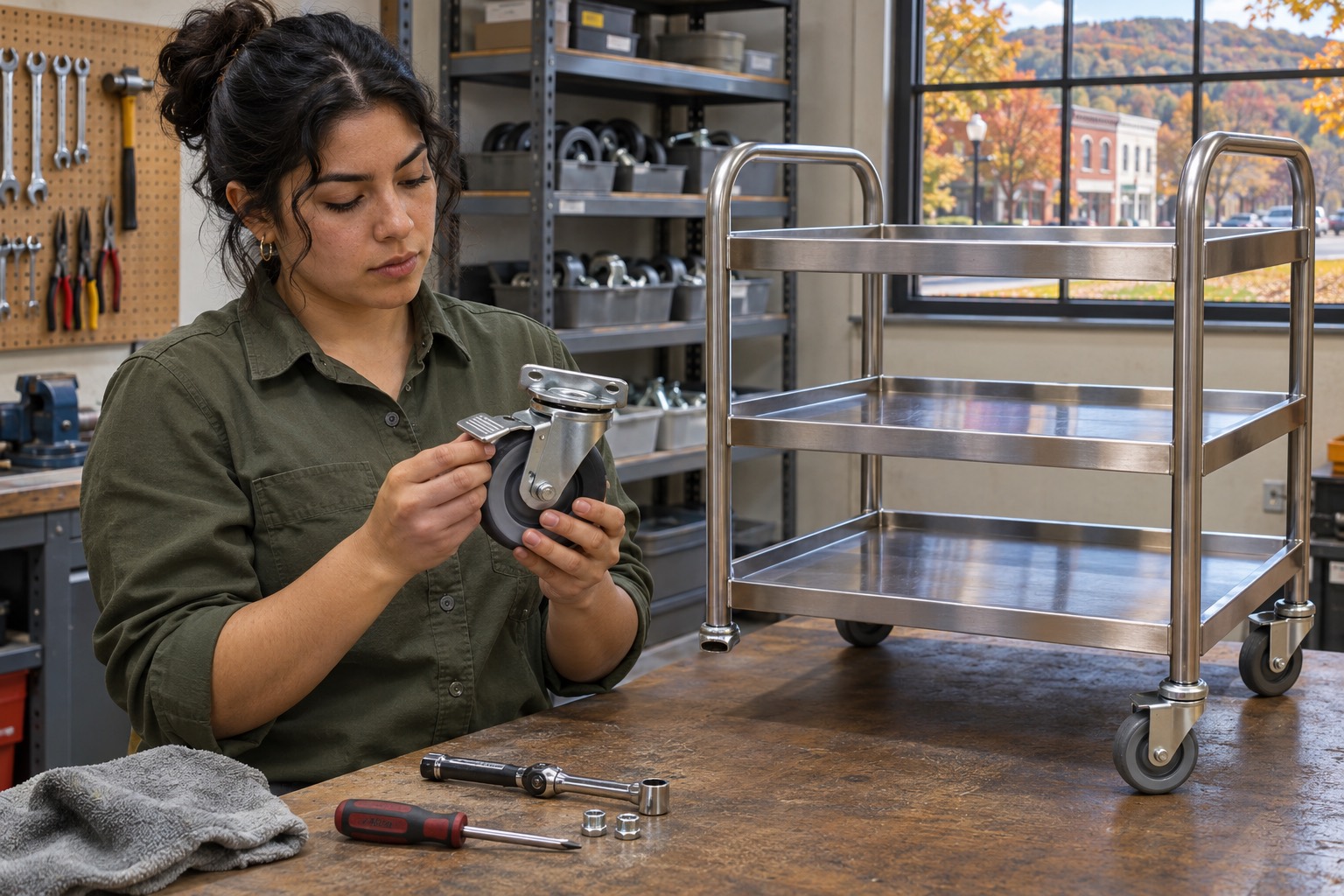
An illustrative equipment workshop checks a caster brake beside an empty stainless service cart. The cart might be owned rental equipment, customer property awaiting repair or an item reserved for an accepted booking. The scene makes no claim about a real Fonda company or a relationship with a local institution. Its useful question is practical: can a successor determine ownership, instruction and readiness from the records rather than infer them from the cart’s place in the workshop? Soften sale talk — no fake Proven Track Record slogans or an unverifiable Fonda street office for Bridge Point Advisors. Compare with Amsterdam, Gloversville, Cobleskill, Utica, Albany only on each company's own files.
Local context. Practical implications.
Reconcile event work with the ordinary operating year
An event-related supplier can buy materials, reserve equipment and arrange labor before the period in which receipts concentrate. Explain how the company funds and organizes that preparation. A buyer needs to understand quieter weeks as well as busy dates, including the cost of maintaining staff and premises between orders. A strong event period can be useful evidence of completed performance without representing a pace that continues every week. Keep the relevant calendar and accounting period clear when comparing results.
An advance payment needs to remain connected to its accepted commitment. A cart reserved for a future job may require inspection, delivery and collection after cash has been received. Another job may be complete but unpaid. Describe those positions separately, showing current status and remaining resources. A buyer reviewing working capital needs cash timing and fulfillment duties together. Neither a full diary nor a bank balance establishes that the company has finished every obligation attached to the money collected.
Equipment readiness is an operating process, not simply an asset list. The illustrative caster brake may need fitting, checking or customer authorization before the cart can be released. Identify who makes the decision and where the evidence is stored. Useful company equipment, reserved items and customer property should be distinguishable in the count. A buyer needs condition and availability alongside ownership before assessing how much working capacity the business actually has at the proposed transfer date.
Describe Fonda operating context through completed work, staffing, and commitments rather than leftover peer-metro multiples.

AI-generated editorial illustration. Not a photograph of an actual local business.
A different sale story for every company
Key industries in Fonda
What owners should prepare before taking a business to market — qualitative preparation, not hard deal tallies.
Equipment rental and practical workshop services
A seller should document ownership, condition, bookings and the procedure for release. The cart example shows why a visually complete item may still need a readiness check. Explain delivery, return and repair effort through completed work. A buyer needs to assess the stock’s usefulness and the staff knowledge required to manage it. Customer equipment must remain distinguishable from company assets, including where the company holds a deposit or has accepted only an estimate rather than authority to repair. See appliance repair.
Fair and event-support businesses
An event supplier should identify the actual purchaser and the dates attached to accepted work. The fair’s own information is event context,[2] while the company’s records establish its income. Explain setup, staffing, transport and follow-up, including resources used outside trading hours. A buyer needs the complete contribution rather than an invoice total detached from preparation and return costs. Keep past participation distinct from a future booking or proposed opportunity whose terms have not been accepted. See event planning.
Public and administrative suppliers
A seller serving public bodies should distinguish Village, Town and County relationships through their purchasing records.[1] Explain who approves work, who accepts delivery and how settlement proceeds. Include administration and any unresolved continuity questions for investigation. A buyer cannot assess concentration from delivery destinations alone. A recognizable office name should remain connected to supported transactions rather than become a broad claim that the company holds ongoing public work across every local department. See consulting.
Independent food and retail operators
A retailer or food business should connect receipts with purchasing, staff cover, preparation and returns or waste as relevant. Event-period sales need their own costs and dates. Explain company performance through records rather than infer it from the fair’s presence.[2] A buyer needs useful stock, working capital and ordinary overhead considered together. Identify reserved goods and advances for future orders so the operating account distinguishes available resources from property or money already committed to completing customer work. See restaurant.
Property, building and community support
A practical support firm should describe its actual scope and access arrangements. The library’s published construction notice illustrates why a destination may require current instructions,[3] without establishing a supplier relationship. Explain travel, staff availability and the process for handling changes to planned work. Another owner needs representative jobs that reveal the whole service sequence. A list of tools and local buildings cannot show how the company responds when a customer’s approval, access or specification remains incomplete. See construction.
Valuation & exit prep
Soften valuation talk to supported earnings after a real manager wage — not a civic caption or leftover peer-metro multiple as twelve months of private profit. See business valuations and the sale-prep roadmap.
The ownership transition
Demonstrate the next preparation and return cycle
Soft process steps aligned with Bridge Point Advisors practice — not invented close counts or a claimed Fonda desk.
Understand the business
A practical handover should follow work through the sequence another operator will inherit. For the illustrative equipment business, demonstrate reservation, condition checks, preparation, delivery and return. Include the response to a missing approval or a cart that is not ready for release. A tour of the store room does not teach those decisions. Staff need to locate current instructions and understand when a routine ends and a different decision or suitable expertise is required.
Prepare the presentation
Discuss proposed seller support through defined activities and availability. Training on bookings differs from help with equipment checks or introductions to purchasers. Record questions where answers can be used by the next operator and keep outstanding matters assigned to a responsible person. Formal terms need appropriate advice. The practical aim is clarity about what has been completed before transfer and what instruction remains afterward, avoiding reliance on a broad assurance that every future issue will receive unlimited help from the seller.
Plan the transition
Match seller assistance to accepted obligations and resources already available in Fonda.
Due diligence
Due diligence — test lease, licenses, customer concentration, and quiet midweeks against local evidence — not a peer metro leftover.
Closing and transition
Closing and transition — hand over routines, contacts, unfinished work, and a clear endpoint so the buyer can run the next week without the founder.
Use the sale-prep roadmap and due diligence guides. M&A advisory fits when the company and buyer require that level of engagement.
Local market perspective
Give future opportunities a separate operating case
Business brokerage in Fonda should distinguish demonstrated earnings from a seller’s proposals. More rental stock, another event or a larger route may be worth investigating, but each requires assumptions about purchasing, labor and working capital. Explain any completed trials and keep their limits visible. The current company should remain understandable without depending on an event booking not yet accepted or an institutional order not yet authorized. A buyer may pursue an opportunity differently or choose to maintain the present scope.
For the illustrative equipment business, another cart adds more than purchase cost. It may require space, transport capacity, inspection time and a plan for repairs between uses. Show how the existing fleet is managed before projecting more rentals. A proposed improvement should address the constraint it solves and the extra duties it creates. A buyer can examine completed operating cycles to assess that reasoning, rather than assume that the availability of more equipment necessarily produces a proportional increase in retained profit.
Compare changes using periods and scope that make sense together. A new delivery charge may coincide with a different event mix or a large unusual order. Explain those factors before assigning the whole result to one decision. Public event or project information can locate the timing,[2][3] while company records are needed to evaluate its own performance. A documented limitation is useful: it tells another operator which question remains open instead of presenting a cause the evidence cannot establish.
A clearer story for a prospective buyer
Fonda, NY and surrounding areas
Providing local expertise
Nearby markets we also serve
Amsterdam, New York
Underwrite on its own records.
Gloversville, New York
Underwrite on its own records.
Cobleskill, New York
Underwrite on its own records.
Utica, New York
Underwrite on its own records.
Albany, New York
Underwrite on its own records.
Spring Hill, Florida
National desk — where Bridge Point lists from.

Begin with a clear picture of your Fonda company
Bring Bridge Point Advisors your sale objectives, an outline of the operation and the records presently available. Explain the working year, important purchasing relationships and the decisions you handle personally. Include questions about equipment, premises, customer property and future accepted commitments that still need investigation. A starting conversation can identify useful preparation for a fuller presentation while keeping supported facts distinct from expectations, giving the discussion a practical foundation in the company and duties another owner would need to understand. Call (352) 515-0226 or contact us.
Or call (352) 515-0226
Questions from local owners
Frequently asked questions
About selling a business in Fonda, New York
Are Village, Town and County orders one relationship?
Their actual purchasing records determine that. The Village’s resources page distinguishes the public bodies and services involved.[1] Identify who approved the company’s order, accepted the work and settled payment. A shared local address cannot establish a single account. A buyer needs the decision structure behind material receipts before assessing concentration or assuming that a relationship with one body covers work for another.
Can a past fair booking be treated as future income?
Past work supports a history of completed trading. The fair’s own website distinguishes its concluded event from preparations for another edition.[2] A seller should identify any accepted future commitment separately and retain its supporting terms. An inquiry, invitation or expectation is different from an order. A buyer can investigate those opportunities without treating every prior event association as revenue already belonging to the company.
How should access changes at a customer site be handled?
Use current instructions for the actual job. The library publishes a rear-entry notice during its building work,[3] illustrating why access information can change. A private seller still needs its own accepted order to establish a customer relationship. Explain who confirms access, what happens if a visit cannot proceed and how the resulting time or transport costs are recorded in the company’s operating account.
What records are useful before an initial sale discussion?
Start with coherent financial reports, an outline of your working role and a current list of major commitments. Distinguish owned equipment from customer property and connect advances to remaining service. Note missing information openly. Bridge Point Advisors can discuss your objectives and available evidence while further preparation remains, giving practical questions a place in the process without implying that every operating detail or proposed transaction term has already been settled.
How do buyers think about value for a Fonda, New York company?
Owner-operated shops often price around two to three and a half times seller's discretionary earnings after a real manager wage. With a lead already holding a quiet midweek, a directional band is often two and a half to four and a half times those earnings. Managed companies often price on adjusted EBITDA, commonly about three to six times near a ten million dollar price. Those ranges are directional, not a quote.
Who helps sell a business in Fonda, New York?
Bridge Point Advisors. Start with a valuation or contact — call (352) 515-0226. The firm works nationally and does not claim a street office in Fonda.

Ready to discuss selling your business in Fonda?
Start with your goals, your recent results, and the company you are ready to transfer. Bridge Point Advisors — call (352) 515-0226. No street address is claimed for Bridge Point in Fonda. Or contact us online.
Or call (352) 515-0226
Local research and sources
[1] Village of Fonda, Community Resources. Reviewed November 5, 2026. Source
[2] Fonda Fair, Official Website. Reviewed November 5, 2026. Source
[3] Frothingham Free Library, Official Website and Building Notice. Reviewed November 5, 2026. Source